
Heat Waves Are Changing Cooling Forever The Hidden Industrial Opportunity

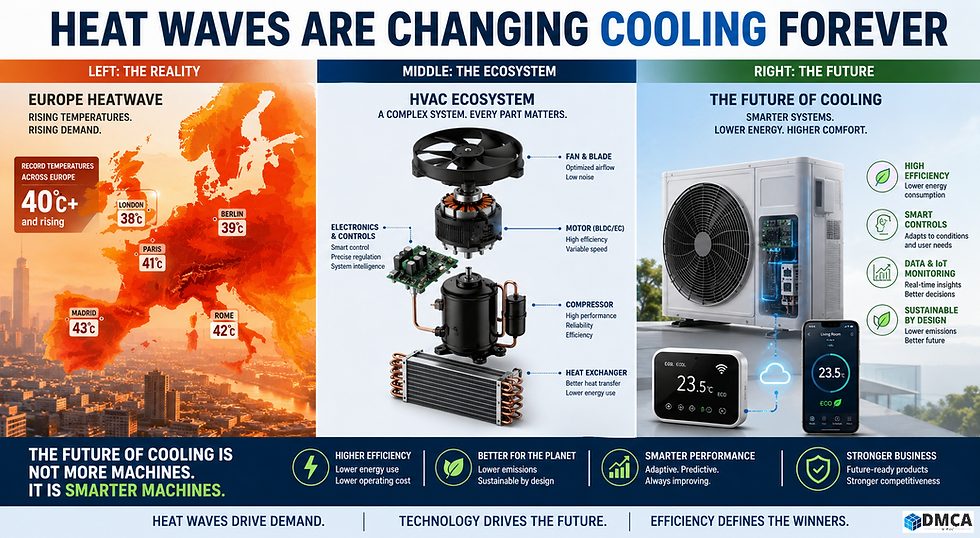
The next decade of cooling will not be defined by comfort. It will be defined by adaptation.
For decades, air conditioning was considered a luxury product in many parts of the world. In regions with traditionally moderate climates, cooling systems were often installed only in offices, hotels, premium buildings, or specific industrial applications.
But climate patterns are changing.
Repeated heat waves are transforming cooling from an optional investment into a necessity.
Europe, in particular, is experiencing a rapid shift as consumers, companies, and public institutions reconsider their approach to indoor temperature management.
This creates a major industrial opportunity — not only for air conditioning manufacturers, but for the entire cooling ecosystem.
The cooling market is entering a new phase
The first reaction to a heat wave is usually simple:
"We need more air conditioners."
But the real industrial challenge is much larger.
The future of cooling requires answering several questions:
How can we produce enough systems quickly?
How can we reduce energy consumption?
How can we make products affordable?
How can we adapt systems to different buildings and climates?
How can supply chains scale sustainably?
The answer will not come from one technology alone.
It will come from the combination of:
efficient compressors
advanced heat exchangers
intelligent controls
high-efficiency motors
optimized fan systems
improved manufacturing capability
Why China became a cooling powerhouse
China has developed one of the world's strongest air-conditioning ecosystems.
The country has built decades of expertise across:
compressor production
electronics
heat exchanger manufacturing
plastic components
motors
fans
complete HVAC assembly
China currently supplies a significant share of global air-conditioning production, supported by large manufacturing clusters and mature supplier networks.
This ecosystem advantage is difficult to replicate quickly.
The competitive advantage is not only labour cost.
It is the combination of:
supplier density
engineering experience
production scale
manufacturing speed
The hidden challenge: cooling requires efficiency
More cooling demand creates another challenge:
More air conditioners also mean more electricity consumption.
The next generation of cooling systems cannot simply be larger.
They must be smarter and more efficient.
This is where technology becomes critical.
Future cooling solutions will increasingly depend on:
High-efficiency motors
Traditional motors still represent a significant opportunity for improvement.
Variable-speed technologies, including BLDC motors, allow systems to adjust performance according to demand instead of operating continuously at maximum power.
Better fan technology
Fans are often underestimated components inside cooling systems.
However, airflow efficiency directly impacts:
energy consumption
noise levels
system performance
reliability
Optimized fan designs, aerodynamic improvements, and efficient motor integration will become increasingly important.
Intelligent control systems
The future cooling system will not simply switch ON and OFF.
It will understand:
room conditions
user behaviour
weather conditions
electricity availability
Smart controls will become a key differentiator.
The opportunity for industrial suppliers
The biggest winners of this market shift may not only be the final AC brands.
A major opportunity exists for specialized technology suppliers.
Companies capable of providing:
efficient motors
electronic controls
fan systems
thermal management components
manufacturing solutions
will play a critical role in enabling the next generation of cooling.
The cooling industry is moving from a product race to a technology race.
The lesson from every heat wave
A heat wave creates immediate demand.
But industrial companies should look beyond the short-term sales spike.
The real opportunity is the structural change behind it:
more regions require cooling
efficiency requirements increase
regulations become stricter
customers expect smarter solutions
The companies that succeed will not simply produce more cooling products.
They will create better cooling technologies.
Final thoughts
Climate change is reshaping industries faster than many companies expected.
Cooling is one of the clearest examples.
What looks like a seasonal challenge today could become one of the defining industrial growth opportunities of the next decade.
For manufacturers, suppliers, and technology companies, the question is no longer:
"How do we sell more cooling products?"
The better question is:
"How do we engineer the future of efficient cooling?"


Comments