
In China, the Wrong Middleman Can Cost You More Than a Bad Deal

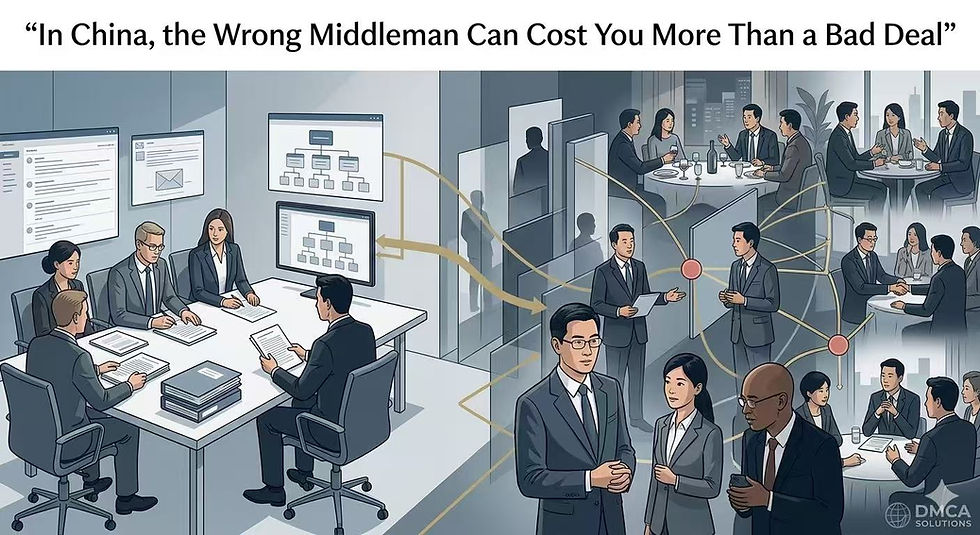
In cross-border business, many foreign companies enter China with a simple assumption:
If we find the right person, things will move forward.
It sounds logical. Even universal.
But in practice, it often leads to one of the most expensive misunderstandings in China-facing business development. Because in many cases, success is not defined by who you know.
It is defined by who actually has access.
And more importantly:
who is trusted inside the decision system.
At DMCA Solutions, we see this pattern repeatedly in sourcing, supplier development, and partnership structuring.
And it always starts the same way.
1. The illusion of influence
At first, everything feels promising.
There is an introduction.
A connection.
A “we can help you” conversation.
But over time, a pattern appears:
meetings multiply
dinners become more frequent
conversations become more indirect
timelines become harder to define
Yet one thing is missing:
The real decision-maker never enters the conversation.
This is where many projects quietly drift off track.
Not because the opportunity is weak.
But because the access was never real in the first place.
2. Influence is not claimed — it is validated
In China, influence is rarely self-declared.
It is confirmed through:
who is willing to be publicly associated
who responds when something is escalated
who opens doors without delay
who carries reputational weight in the network
Unlike formal systems where authority is documented, here it is often distributed through trust networks. And that makes misreading influence very easy for outsiders.
3. The three signals that matter
There are three practical indicators that tend to reveal the quality of a middleman.
① Real credibility vs claimed credibility
Anyone can say: “I know people.”
But real credibility is visible indirectly:
Do others reference them independently?
Is their reputation consistent across different contacts?
Do they appear in real decision contexts, not just introductions?
In these environments, reputation travels quietly — but it travels far.
② Who you are actually being brought to
A strong connector reduces distance. A weak connector maintains dependency.
Over time, this becomes visible:
Strong access → movement toward decision-makers
Weak access → repetition of introductions without authority
Stalled access → no one with real decision power appears
At that point, the signal is already clear:
You are inside a conversation loop, not a decision loop.
③ Transparency of the process
Reliable connectors tend to:
explain constraints
clarify expectations
define realistic pathways
acknowledge risks early
Less reliable ones often operate through ambiguity. And ambiguity has a structural effect: the less you understand, the more dependent you become.
That dependency is where risk accumulates.
4. The diagnostic question
One of the most effective ways to test reliability is simple:
“If this does not work, what happens next?”
Strong partners will answer with structure:
alternative routes
escalation paths
realistic fallback options
Weak ones often shift language:
“let’s see”
“no problem, trust me”
“we will manage it”
The difference is not communication style. It is whether a system exists behind the relationship.
5. Why this is more critical in China than elsewhere
Middlemen exist everywhere. But their role is not identical across systems.
In many Western environments, intermediaries function as:
facilitators
industry connectors
efficiency layers inside rule-based systems
The underlying system still relies on:
formal authority
documented processes
institutional validation
In China-facing environments, however:
access is more relational
authority is more distributed
validation is more network-based
trust precedes formal recognition
Which means the middleman often becomes:
a trust bridge
a gatekeeper
a filter into decision circles
And sometimes, unintentionally:
a bottleneck between you and reality
6. The structural misunderstanding
Many foreign teams believe they are negotiating with: a company
But in reality, they are often navigating: a relationship network around the company
And the middleman determines:
who gets introduced
who gets delayed
who gets access
who never reaches the real decision layer
This is why outcomes can diverge so dramatically from expectations, even when the formal agreement looks correct.
7. Two types of middlemen
Over time, two categories consistently emerge:
Bridges
shorten distance
accelerate clarity
connect directly to decision structures
reduce dependency over time
Traps
extend the process
multiply intermediaries
increase information asymmetry
keep decision-makers out of reach
The difference is rarely visible at the beginning.
It becomes clear only through flow of access.
Final Thought
In China-facing business, the risk is rarely the lack of opportunity.
It is the misinterpretation of access.
At DMCA Solutions, we focus on helping industrial teams structure relationships that connect them to real decision paths — not just visible introductions.
Because in complex ecosystems:
The wrong middleman does not just slow you down.
They can define the outcome before the negotiation even begins.



Comments