
The Transformation of China: From Low-Cost Manufacturing to Competitive Industrial Ecosystem

After more than a decade supporting European industrial companies from within China, and following recent executive discussions including the China 2026 Business Forecast – Compete in China, Win Globally, one thing is clear:
China is no longer a cheap manufacturing base. China is a competitive industrial ecosystem.
And that changes everything.
1️⃣ The End of “Cheap China”
Labor costs have increased significantly over the past 15 years. Environmental compliance is stricter. Quality standards are higher. Technology integration is faster. If your sourcing strategy is still built on a 2008 cost structure model, you are already misaligned.
Yet here is the paradox: China is becoming more competitive — not less.
Why?
Because competitiveness is no longer about wages. It is about:
Supply chain density
Speed of execution
Engineering iteration cycles
Industrial clustering
Capital efficiency
In many sectors, Chinese development speed is now estimated at 2–3x Western benchmarks.
Cheap? No. Fast and scalable? Absolutely.
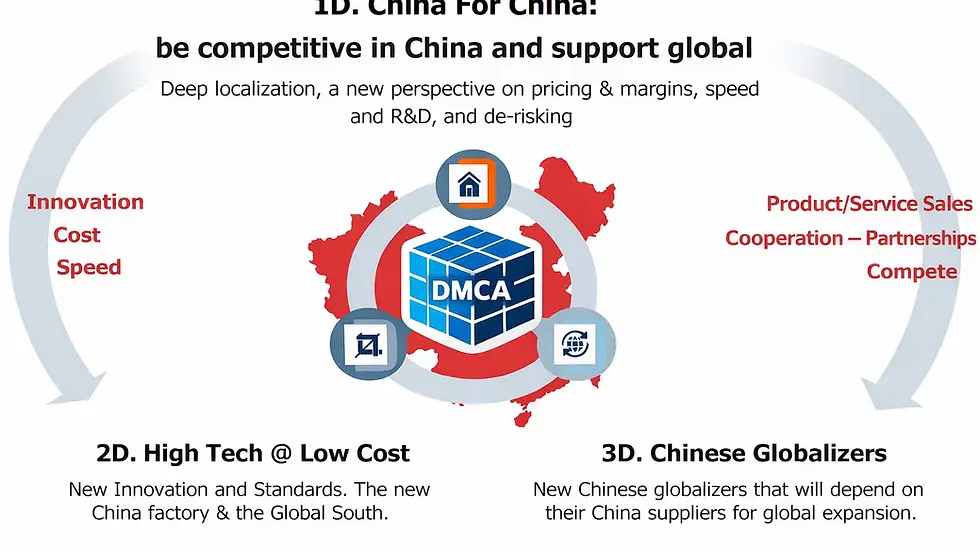
2️⃣ The Rise of “3D China”
A structural shift is happening. We increasingly see three operating dimensions emerging:
1D – China for China
Deep localization.
Strong price pressure.
Massive consolidation.
High M&A activity.
2D – High-Tech / Low-Cost Players
Chinese manufacturers are operating sustainably at lower margin expectations, progressively entering premium segments. This is where many Western buyers make a strategic mistake: They underestimate how fast quality levels are climbing.
3D – Chinese Globalizers
An increasing number of international projects are:
Sold from China
Engineered in China
Managed from China, even when executed abroad.
The center of gravity is shifting.
3️⃣ Is Quality Still a Risk?
The real question is no longer “Is China cheap?” It is: Can you identify the right tier within China’s industrial pyramid?
China today contains:
Commodity producers
World-class engineering firms
State-of-the-art automation manufacturers
Globally competitive OEM partners
The gap between bottom-tier and top-tier suppliers is enormous. This is where structured sourcing, on-the-ground validation, and supplier qualification become critical.
At DMCA Solutions Limited, most of our projects are no longer about “finding the lowest cost.” They are about:
Risk mitigation
Supply continuity
Component reliability
Multi-sourcing strategy
Engineering validation
Cheap sourcing destroys value. Structured sourcing builds resilience.
4️⃣ Structural Cost Dynamics: The Hidden Advantage
Despite wage increases, China currently operates in a relative deflationary environment compared to US/EU inflationary pressure. This creates a mechanical long-term competitiveness effect.
Even without structural improvements, cost divergence alone reshapes global pricing power. The real advantage is no longer “cheap labor.” It is industrial system efficiency.
5️⃣ What This Means for Industrial Leaders
If you are a CEO, COO, or Supply Chain Director, the strategic questions are now:
Do we treat China as a low-cost supplier — or as a strategic industrial platform?
Are we adapting our product design to regional standards?
Are we building operational autonomy with governance integrity?
Are we prepared for bifurcated R&D models?
Companies that win in 2026–2030 will not be those that chase price. They will be those that understand:
China is no longer the world’s factory. It is becoming one of the world’s industrial architects.
6️⃣ Final Thought
China is not cheap anymore. But it might be one of the most competitive industrial ecosystems on the planet. The difference lies in how you approach it.
7️⃣ Embracing Change: The Path Forward
As we navigate this new landscape, we must embrace change. The traditional mindset of viewing China solely as a low-cost option is no longer viable. Instead, we must recognize the value of strategic sourcing in Asia.
By understanding the complexities of the Chinese market, we can build resilient supply chains. This approach minimizes risks and optimizes production outcomes. Ultimately, it strengthens our competitive edge in the global market.
8️⃣ The Importance of Strategic Partnerships
In this evolving environment, forming strategic partnerships is crucial. Collaborating with local experts can provide insights into market dynamics. This can help us identify the right suppliers and ensure quality.
Moreover, these partnerships can enhance our ability to adapt to changes quickly. They allow us to leverage local knowledge and resources effectively.
9️⃣ Conclusion: A New Era of Sourcing
In conclusion, the era of viewing China as merely a low-cost manufacturing hub is over. We stand at the threshold of a new era of sourcing. By embracing the competitive industrial ecosystem that China has become, we can unlock new opportunities.
Let’s move forward with a fresh perspective. Together, we can navigate this complex landscape and achieve success.


Comments