
Off-Highway Market Outlook 2026: Positioning Supply Chains for the Next Cycle
- DMCA Solutions

- Apr 7
- 3 min read

The off-highway sector is entering 2026 at an inflection point.
2025 is projected to remain below 2024 levels across most developed markets. However, signals indicate that the industry may be approaching the bottom of the cycle, with recovery expected in 2026 and stabilization into 2027.
For OEMs and industrial suppliers, the question is no longer short-term volatility.
It is how to structurally prepare supply chains for the next growth phase.
At DMCA Solutions, we see five strategic signals that sourcing leaders should integrate now.
1️⃣ 2025: Below Peak, But Likely Near the Bottom
Across developed markets:
Construction equipment demand softened
Agricultural machinery impacted by macro uncertainty and geopolitical tensions
Inventory correction continues
However, forward-looking indicators suggest that 2026 may mark the beginning of recovery, particularly in developed regions.
This creates a strategic window:
Renegotiate supplier frameworks while volumes are moderate
Optimize cost structures before demand rebounds
Strengthen supplier qualification before next growth cycle
The bottom of a cycle is when structural advantages are built.
2️⃣ United States: Data Centers Driving Selective Growth
In the US, construction demand remains uneven.
While traditional segments are soft, data center infrastructure projects continue to support activity, creating selective resilience in construction machinery demand.
Agriculture remains under pressure due to global trade dynamics and the Ukraine–Russia conflict, but 2026 could see stabilization.
Implication for suppliers:
Segmented demand requires segmented sourcing strategy.
Overgeneralization creates either overcapacity or missed opportunity.
3️⃣ China: Accelerating Global Expansion
Chinese OEMs are increasingly pushing international markets:
Expansion across Asia, South America, and Africa
Stronger European market ambitions
Visible capital market activity (e.g., Sany international positioning)
Continued focus on electrification
China is no longer just a production base.
It is becoming a global competitor in higher-value segments.
For European OEMs, this means:
Competitive benchmarking must be continuous
Strategic supplier partnerships in Asia must be structured
ESG and compliance evaluation cannot be assumed
Execution discipline becomes critical.
4️⃣ Electrification & Electronics: Reshaping Value Chains
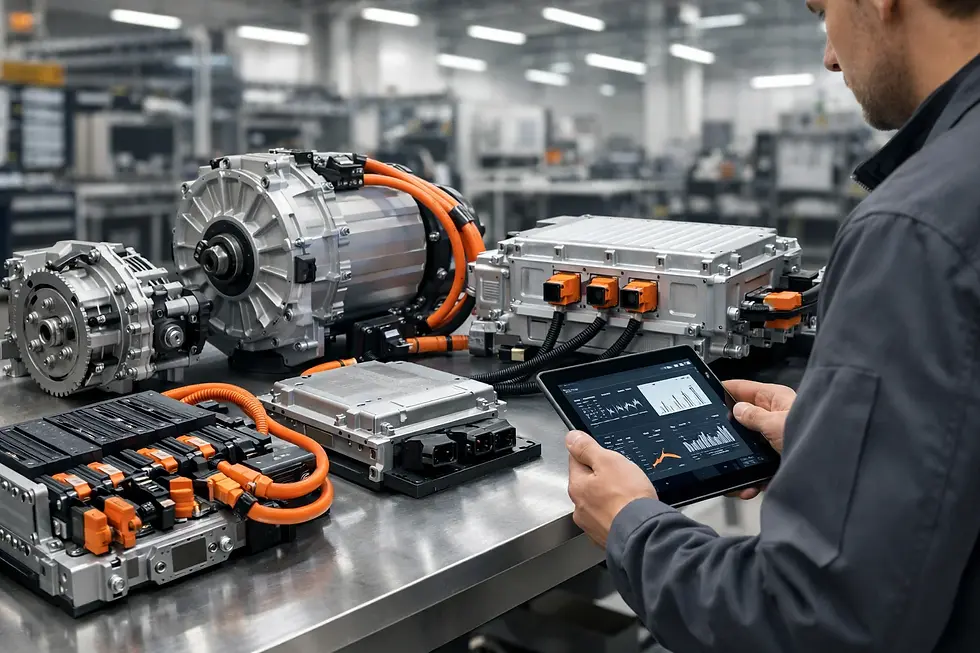
Electrification remains a long-term structural shift.
However, its impact goes beyond replacing diesel engines.
It is reshaping the value chain through:
Power electronics
Battery systems
Automation integration
Smart control systems
Electronics content per machine continues to increase.
This shifts supplier dependency from mechanical components toward electronic ecosystems.
Sourcing strategy must therefore include:
Electronic supplier qualification capability
IP risk assessment
Cross-border technical validation
Long-term partnership structuring
Electrification is not just a product roadmap decision.
It is a supplier ecosystem redesign.
5️⃣ Regional Divergence Requires Regional Strategy
Market dynamics differ significantly:
Europe: mixed outlook, country-specific dynamics (UK, Germany, France)
India: infrastructure-driven upside expected despite short-term volatility
Japan: moderate export-driven growth
US: selective strength in infrastructure
China: outward expansion acceleration
One global sourcing model no longer fits all.
Regional flexibility must be engineered — not improvised.
Strategic Implication for OEMs
As markets approach cyclical stabilization, leading companies will:
Rebuild negotiation leverage
Optimize supplier portfolios
Dual-source critical technologies
Integrate electronics sourcing earlier into product development
Strengthen ESG validation across international supply chains
Supply chain strategy is no longer operational.It is competitive positioning.
Conclusion
The off-highway market is not collapsing.
It is resetting.
2025 may represent the bottom of the cycle.
2026 could mark the next phase of disciplined growth.
Companies that use this transitional period to:
Requalify suppliers
Strengthen cross-border sourcing
Prepare for electrification complexity
Mitigate regional exposure
will enter the next upcycle structurally stronger.
At DMCA Solutions, we support OEMs in turning market transition into sourcing advantage through:
Strategic supplier identification
Europe–China–Southeast Asia bridging
Structured qualification & audit
Risk mitigation before scale-up
Because in cyclical industries,
preparation during slowdown defines performance during recovery.


Comments